
Rubio kindly suggests replacing Western values with American interests
This year I'm leaving the Munich Security Conference in a mood which diplomats would describe as “thoughtful”.
We can call this progress, as my mood in previous years was famously gloomy.
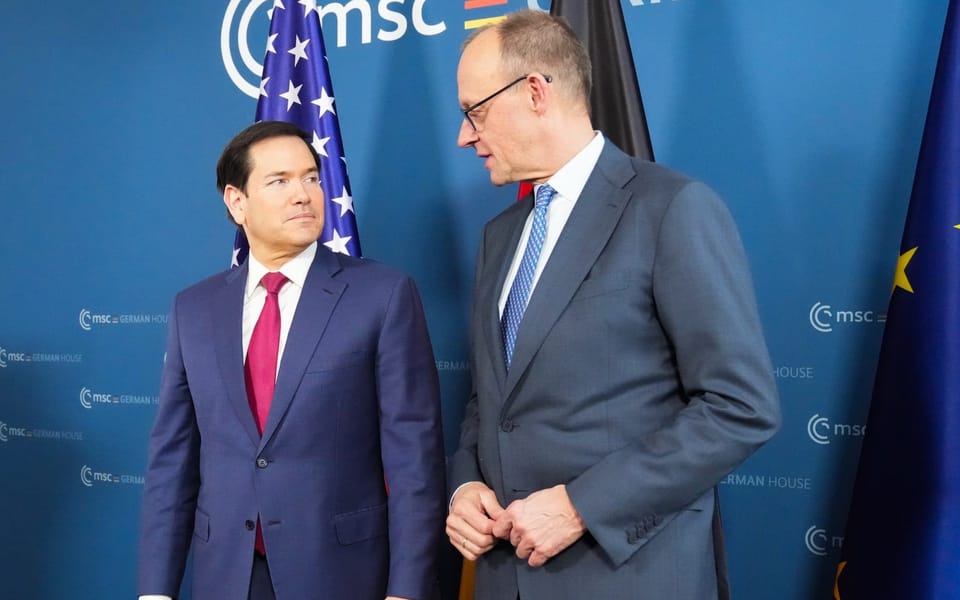
The main highlight was obviously Secretary of State Mark Rubio’s speech.
Opinions differ on whether it was an outstretched hand and an invitation for a conversation, or just the same signalling to Europe but wrapped in fancy paper. Whichever side of that debate you are on, I think it’s a sideshow.
While everyone in Europe is discussing what the latest American speech means, I don't believe many people are discussing the speeches of Europeans in the US.
That means Europe is once again on the receiving end of a strategy imposed by others.
The current US administration is suggesting a very specific view of what “Western alliance” means, and their view is more aligned with that of their President’s electorate than with that of the average European.
This means that even if it is a call for a conversation it might be a very short lived one. Europeans do believe in individual freedoms, free trade, do believe that the countries constituting the European Union are sovereign, at least most of them do trust in climate science.
And if things are not working, Europeans tend to fix them via elections and smarter decisions, not revolutions – The current German administration took measures to curb migration, the European Commission is reversing some of the more extreme regulations. And Europeans don’t feel like they are in civilisational decline. What they see in their streets is very different to what some Americans see on sensationalist YouTube channels.
And we Europeans really do still believe in values. Like, for example, the values of democracy, rule of law, territorial integrity. Since the tragedies of the Second World War, a common understanding of these values has brought us together as a peaceful community, and we tend to be concerned about protecting the values that brought us our prosperity and stability.
Nobody forced the people of Europe to support Ukraine, to receive Ukrainian refugees, to raise millions for Ukraine, to vote for politicians who support Ukraine. But they overwhelmingly did, even though Russia’s TikTok influencers and Facebook fake accounts tried very hard to stop them.
So I don’t think that Europeans should preach, panic or despair about the changes in the values held dear by those running the United States. Every country is free to choose their world view. The US chose theirs, and they aren’t asking for Europe’s input in their decisionmaking.
But Europeans are also free; free to continue protecting their core democratic values from whoever tries to undermine and corrupt them. Free to point out differences in values, and to explain to electorates why these differences matter.
Europe has to be ready to defend the values its vast majority holds dear.
Europe has to be prepared to help defend other democracies anywhere in the world if they are under attack. And they always are.
Europe has to show readiness to cooperate closely with those who share our values.
Europe can of course cooperate with those who share our interests, but be mindful that interests do change—for example—trade can be made into a political weapon very quickly. Such pivots are less frequent when values are aligned.
Europe has to be ready to present its own version of the transatlantic agenda - a partnership, but without compromising on what is most important. And what is most important is values.
But can we achieve that?
There are still people upset and confused about the fact that Europe is not invited to the negotiations between the US, Russia and Ukraine. But Europe had the opportunity to do what it takes to command an invite to such talks. Leaders chose instead to dither, and so they were forced to accept whatever everybody else decides.
Opening a diplomatic channel to Putin cannot create a negotiating table, it can only gift him yet another display of European self-humiliation.
At some point, we must pivot to the solutions that actually work.
Europe is still sovereign, and still has its core values. Europeans have the capability to carpe diem, to finally display all of our strength and resolve, at any time we choose. Europe also has the power to make strong and mutually beneficial alliances with those around the world who want to share our values.
I am thoughtfully suggesting we do all this sooner, restoring our dignity while we still have the strength and values we currently have, rather than trying later, when our influence in global affairs has declined further by our inaction, and things have become very gloomy for everybody.
If you appreciated this article and you would like to support our work, join Friends of Democracy today!



Member discussion