
Dear Mr. Rutte, I'm not dreaming, I'm having nightmares

I presume that the NATO Secretary General’s messaging about Europe’s inability to fight Russia alone was intended for Europeans as a warning against shutting the door on transatlantic cooperation. Well, nobody is shutting that door just yet, but I would argue that it is nevertheless prudent to consider the possibility that a war with Russia, if it came to that, might have to be fought by Europeans alone. Preparing for such an eventuality should not be taboo, and discussion of contingencies should not be ridiculed.
Furthermore, it is worth discussing how Mark Rutte’s messaging might have been interpreted by our adversaries.
In the face of an existential threat, in a recent meeting at the European Parliament, Mr. Rutte said that those who think Europe could defend itself without US support are “dreaming”.
This de facto defeatism diminishes Europe’s ability to deter Putin. Bullies aren’t deterred by loud declarations of vulnerability, they are emboldened and encouraged. I feel a little uneasy watching a NATO Secretary General choosing this particular communication strategy.
But Mr. Rutte’s much-repeated soundbite must have been music to Putin and Xi’s ears for an even more fundamental reason, which is further deepening my concern.
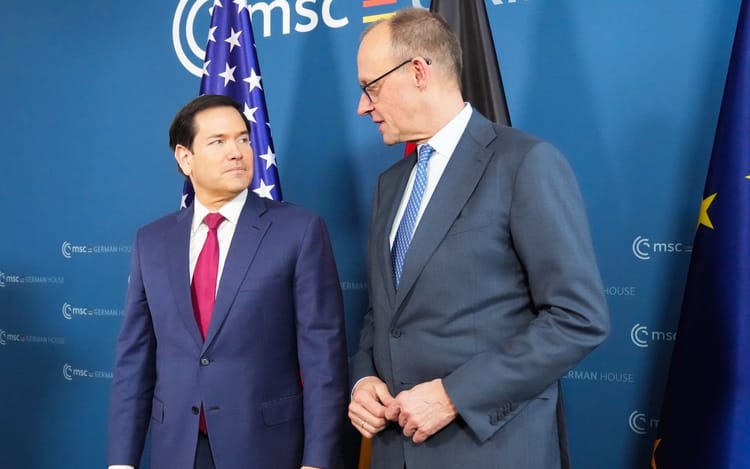
I remember that not long ago, the same Mark Rutte, during a joint press conference with Chancellor Merz, warned that if China decided to launch an attack on Taiwan, they would likely coordinate with Russia to create a parallel conflict to keep the West overstretched. I agree with the assessment, this does indeed seem to be their plan.
Therefore, both our adversaries must have been delighted to have received loud confirmation, from the head of NATO himself, that their dual-theater strategy can indeed work. If the head of NATO is certain that Europe cannot defend itself without US support, he is implying that the US will face a serious dilemma - either lose Europe to Russia, or Taiwan to China.
Rutte’s “dreaming” speech, rather than serving as a rallying cry for the transatlantic partnership, might have been welcomed by the Chinese as a self-fulfilling prophecy of success if they do exactly what they are planning to do.
A stronger NATO strategy would be to confirm and further increase transatlantic readiness to fight in two theatres at the same time, so that Putin and Xi would themselves be presented with a dilemma requiring their attention and resources. But this is not what we hear from Mr. Rutte, and not what we read in official documents coming out of Washington. Why not?
I hear a lot about pragmatism. Mr. Rutte’s “pragmatic” approach seems to be declaring, and even exaggerating, weakness in order to justify the need for US support. But nobody was really questioning that need for that. Nobody is seriously saying Europe should choose to go it alone and burn all bridges, but some of us are saying we might not get a choice, and Mr. Rutte’s assumption that the US would split its forces to save Europe from Russia is looking more and more dreamlike as time goes on.
The important question Mr. Rutte side-stepped is this: What must be done to prepare Europe to fight in the increasingly likely and terrifying scenario B, i.e. without our main ally? In the light of recent developments, it seems to me that the pinnacle of pragmatism would be to at least have an honest conversation about this very real possibility.
If you appreciated this article and you would like to support our work, join Friends of Democracy today!



Member discussion